

Pearls, diamonds, and gold represent wealth and opulence. All three demand large amounts of money to be obtained. Only nobles and kings possessed such rare items. Today, a set of cultured pearls might set a husband back $500 to $5000 for a string of 50 pearls.
Pearls captured the imagination of ancient cultures. The Hindu holy books record that their god, Krishna, found a pearl in the sea and promptly surrendered the pearl to his daughter, Pandaia, on her wedding day. The Egyptians utilized mother-of-pearl as far back as 4200 B.C.
 A pearl earring, once owned by the Roman General Vitellus (pictured), provided the general with enough funds to capitalize an entire military operation according to the first century Roman historian, Suetonius.
Enamored by pearls, Roman women even covered their furniture with pearls. Roman women sewed pearls onto their gowns and would walk upon the pearls in the hems of the gowns. Not to be outdone, the Romans Emperor Caligula, proclaimed his horse a proconsul and decorated the horse with pearls.
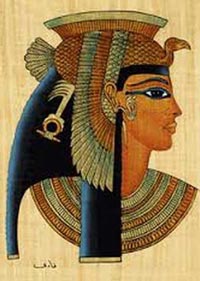
A pearl figured in what literature records as the most expensive dinner the world has witnessed. Cleopatra desperately needed to persuade Marc Antony the Egypt’s wealth and heritage that raised the country above conquest. While Marc Anthony lounged at the table with an unfilled plate and a goblet of vinegar (or wine), Cleopatra took a pearl earring, crushed it, liquified it, and then, drank it. Witnessing this, Marc Antony left his plate empty and the matching pearl earring. He conceded defeat.*
IDENTIFYING THE PEARLS OF POETRY
The richness of poetry is almost without end. Poetry is the second most occurring literary genre in the Bible behind narratives. Several features separate biblical poetry from prose. Parallelism or rhythmic balance stands as the most important feature. Terseness and shortness of lines provides a second feature. Third, Hebrew poetry leans towards the avoidance of conjunctions and particles. Finally, Hebrew poetry prefers to use simple, figurative language: (hyperbole, metaphor, personification, and analogy, etc.,) or extended (idioms, riddle, parable, or similitude etc.).
WHAT MOTIVATED BIBLICAL WRITERS TO EMPLOY POETRY?
Biblical writers employed the pearl of poetry because poetry expresses a richness which prose cannot. The ideas carried by poetry transmits more power than prose. Poetry possesses more emotional power than prose. Poetry may lead one to action, to change attitudes, or even comfort a grieving heart. Many of Jesus’ teachings gain a richness if the reader appreciates the poetry found in His words and teachings.
Biblical poetry adds beauty intending to increase the dramatic and emotional impact of the words upon its audience. These forms of parallelism fill the understanding in a greater way than a single sentence or phrase. Perhaps more important for an ancient culture was its adding to the ease of being memorized.
GENERAL PRINCIPLES CONCERNING THE PEARLS OF POETRY
Biblical poetry cannot be read like prose. The writer of biblical poetry concerned himself with arousing emotions and creating certain impressions rather than exact accounts and scientific definitions.
FOUR PEARLS OF POETRY



As a rule English poetry consists of rhyme and rhythm. Consider the poem:
“The Spider and the Fly” by Mary Howitt
“Will you walk into my parlour? Said the Spider to the Fly?
“Tis the prettiest little parlour that ever you did spy,
The way into my parlour is a winding stair,
And I’ve many curious things when you are there.”
The rhyme is seen in lines 1 and 2: fly – spy as well as lines 3 and 4: stair – there. Likewise, rhythm stands more important for English poetry. Lines 1 and 2 have 15 and 14 syllabus while lines 3 and 4 have 12 each to provide the rhythm.
In Hebrew poetry, the thing that is similar is parallelism. Some of the traditional terms to define this parallelism include:
 PEARL 1: Synonymous Parallelism –
The second and following lines of synonymous parallelism must duplicate the idea of the first line with a different, but similar idea.
Matt 7:7-8 –
Ask, and it will be given to you;
Seek, and you will find;
Knock, and it will be opened to you.
For everyone who asks receives,
And the one who seeks finds,
And to the one who knocks it will be opened.
Asking, seeking, knocking are similar but different means of praying. Two lines are required for synonymous parallelism, but more can be included.
The interpretive principle for synonymous parallelism is that each line must stress the same truth.
PEARL 2: Antithetical Parallelism –
Antithetical parallelism requires the second line to contrast the first line. This is the most common kind of parallelism in the Bible. Jesus’ teachings alone provide for over 130 examples. Entire chapters of Proverbs are antithetical parallelisms.
Proverbs 15:17 –
Better is a dinner of herbs where love is
Than a fattened ox and hatred with it.
Antithetical parallelisms are generally limited to two lines. Occasionally a third line may exist such as in Matthew 10: 32-33.
Remember that these are poetry and poetic license may be intended by the author. To interpret this poetry, understanding one line provides the key to understanding the second line.
PEARL 3: Climatic or Step Parallelism –
Step Parallelism allows the second line to pick up the idea of the first line. The second line does not repeat the idea of the first line, but advances the thought or moves the thought of the first line to a higher plane with the intention of bringing the idea to a peak. This form is not as frequent as the first two pearls. An example is Matt 10:40 –
And whoever receives me receives him who sent me
Whoever receives you receives me,
Pearl 4: Chiastic Parallelism
The fourth parallelism found in Scripture is chiastic which reveals itself in a particular parallelism structure. Statement 1 has two elements: A and B. The second statement has two parts as well, but in reverse order. B and A. See Matthew 23:12
A. Whosoever exalts himself
B. Will be humble
B’ and whoever humbles himself
A’ will be exalted.
Interestingly the chiastic parallelism may be either synonymous or antithetical in meaning. Scholars have identified additional types of Hebrew poetry, but these are the major four found in the Old and New Testaments.
THE PEARLS OF POETRY IN THE WORDS OF JESUS –

Would you be surprised that the recorded words of Jesus contain 220 examples of parallelism? Without a doubt, Jesus intended to impact the emotions of his audience. Jesus sought to evoke an emotional response with His words. Perhaps if a speaker, preacher, or teacher today wants his words remembered, he might consider using parallelism.
Share with me your favorite Psalm or Proverb and why it is your favorite. When you share with me, I will share mine with you on Monday, November 5, 2018 after everyone has had an opportunity to share this week.
Blessings and prayers!
*This feature originally appeared on the site for the NOVA program The Perfect Pearl.https://www.pbs.org/wgbh/nova/article/history-pearls/

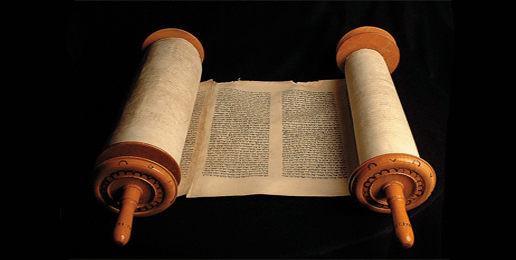
 The Law of the Old Testament does not represent a full legal system with crimes and punishments spelled out. Often, there is no stated penalty for failure to keep the Law and no one is especially tasked to enforce the Law. The Old Testament Law appears to promote a self-enforcement on the Israelites.
 Always apply laws to the New Testament parallel of the original audience. If a Law speaks to the nation of Israel as a group, this can be applied to Christians in general.














 When we approach God’s Word, we must know how to discover God’s original intention and what it means, not merely what it means to you.
 This implies that the interpreter possesses a vital relationship with the God of the Bible. Does it make sense that if one denies the existence of God, the Bible cannot have meaning for such a person? How or why would someone as such want to read or study the Bible? Hebrews 11:6 indicates that it takes faith to please God since you must believe God exists and that He rewards those who seek Him.” Please understand that I am not saying that the unbeliever cannot grasp some of the facts and truths of the Bible – but such a person can never embrace the Bible as God’s full revelation of Himself. Nor do I believe that every sincere believer will always produce a ‘correct’ interpretation. But it is the role of the Holy Spirit to guide the believer into truth. Let’s determine to ask Him. See point 3 below.


 Truth-Travelers